It Crashed, Then Soared — Price Was Never Reading the Fundamentals!
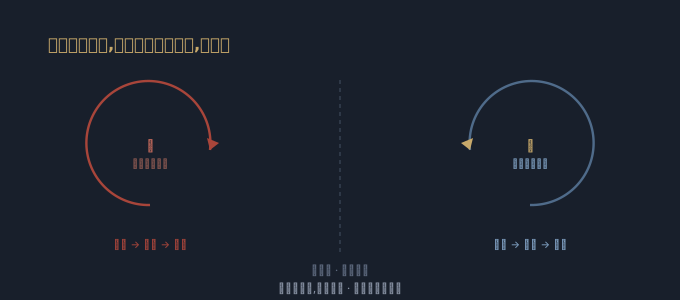
On the way down, everyone talks fundamentals. On the way up, everyone talks fundamentals too. But the fundamentals cannot change in a single day.
Overnight — small hours here — the Nasdaq jumped nearly 3%, snapping a six-day losing streak in one session. It was led by a strong cloud print from Microsoft and a broad blowout in the chips behind it: semiconductors rose 8% in a day, though not one of those companies sold a single extra chip overnight. And still the recaps sing one note: the shoe dropped, the dip is over, the fundamentals were never that bad.
Yet just one day earlier, the same stocks, the same Fed, the same companies — the Dow shed more than a thousand points in a day. In twenty-four hours the businesses did not change, the rate did not change; only the price changed. The same set of fundamentals threw off panic yesterday and euphoria today.
Which forces open something many people would rather not admit: in the short run, price is not reading the fundamentals at all. It is reading positioning.
Pry the word “price” apart first. Price is supposed to be a collective computation of a company’s future — what it is worth, what it will earn, millions placing their bets and aggregating into one number. When a trend is healthy, it really is computing the future. But once emotion and positioning stretch to an extreme, that computer degrades. It stops calculating what the company is worth and calculates one thing only: how much is still in other people’s hands, waiting to be sold — or forced to be bought.
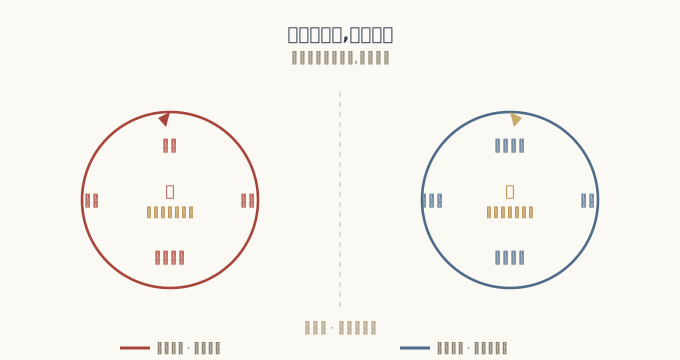
So you get the loop that steps on its own foot. On the way down: fear forces selling, selling drops the price, and once the price is down, accounts show losses, more hands are forced to sell, and the price drops again. The fall itself manufactures more fall. Six straight down days were not the fundamentals breaking six times over; they were this self-reinforcing machine, flooring the pedal for six full days.
Run it backwards. On the bounce: over-stretched shorts begin to cover, buying jacks the price up, and once the price is up, more shorts are squeezed into buying to close out, and the price rises again. The rise itself manufactures more rise. A near-3% pop was not the fundamentals healing overnight; it was the same machine, lifting one foot and flooring the pedal in reverse.
The clearest tell is that memory giant. Weeks ago it delivered its strongest quarter on record, data-center sales up several-fold; yet on the way down it still followed the tape and lost almost a tenth of its value in one session. What sold it off was not its own business — its business could not have been better — it was everyone wanting out of their positions at the same moment. The best earnings in its history could not keep a stock from falling in lockstep with positioning.
And today’s blowout in the chips is, likewise, not those companies selling more silicon overnight. A single Microsoft print merely served as the fuse; the real charge was the short positioning that had been coiling tighter for six days. A fuse only lights it — the energy that goes off was packed into the positioning all along.
In the end, fundamentals are the long-run anchor of price, not its daily steering wheel. The wheel is in the hands of positioning. What a company is truly worth takes years to reckon; whether it rises or falls today turns only on whether, right now, there are more who want to sell or more who are forced to buy. The nearer the extreme, the farther price drifts from the fundamentals and the closer it hugs itself — all its compute burned on who has not covered yet, with none left over to compute the company’s future.
So do not read this bounce as the market finally coming to its senses. It came to no senses; it merely let a rubber band stretched to its limit snap back an inch. When the snap is done, the fundamentals are the same fundamentals, the Fed is the same Fed, nothing has changed. What a rally or a rout hands you is never news about the company; it is a mirror of the crowd itself.
The easiest mistake a person makes is to take the mirror for a window. Watching the price surge, they think they glimpse the company’s future; watching it crash, they think they glimpse the end of the world. But there is nothing behind that glass at all — only their own face, greedy or afraid, reflected back. The margin of safety was never in the price; it is in whether the company can earn more money many years from now — and about that number, a day of crashing and soaring says not one word.
A crash and a surge read no earnings report; they read the human heart.
SECURE PAYMENT VIA STRIPE
Subscribe: $50 annual pass unlocks every paid article on this site for one year
Go deeper: Ko-fi members get a weekly members-only deep dive, from $3/month Become a member →