It Never Lost the Money — Bitcoin's Price Just Moved Onto Its Books!
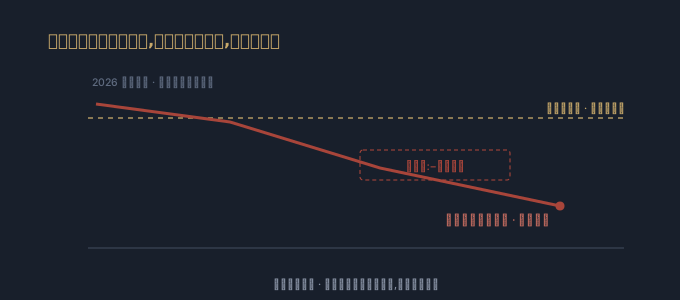
From the July 30 after-hours print through this Monday, one number is everywhere: Strategy — the old MicroStrategy — “lost” more than eight billion dollars in a single quarter. Worst ever. The headlines climb over each other: the treasury model is buckling, Saylor’s great bet has blown up.
That reading mistakes a bookkeeping entry for a bleeding.
It never lost the money. That eight billion is bitcoin’s price falling, entered onto its books.
Pull the number apart. That eight-billion-plus “loss” is, almost to the dollar, a single accounting remeasurement: the new fair-value rule requires it, every quarter-end, to re-mark its bitcoin to the going market price. This quarter bitcoin slid from the mid-eighty-thousands toward sixty-five, and the great pile of coins on its books got “marked” down by eight-billion-odd. But not one cent of that money left the building. Nothing was paid to anyone, nothing lost to anyone — a figure on a ledger simply shrank from large to small. It is not a bleeding. It is stepping on the scale and reading a lighter number.
What gives the game away is a few other lines in the very same report. In the quarter it supposedly “lost eight billion,” it raised more than eight billion dollars of real cash by issuing stock; it cut its debt by nearly a fifth; and its bitcoin holdings did not shrink — it bought more, to a fresh all-time high. A company that is genuinely bleeding does not, in the same quarter, take in cash by the fistful, pay debt down step by step, and still have room to add to the position. In the end, of that eight-billion loss, not one cent ever actually left it.
So what does that income statement record?
Glance at its “real business” and it becomes obvious. It sells software; a quarter of that brings in a hundred-odd million dollars. Set that hundred-odd million beside the eight-billion “loss” — the company’s actual body is smaller than the rounding error on its own loss. Which tells you the thing heaving and churning across that income statement is not the operations of a software firm at all. It is the eight-hundred-thousand-odd bitcoin in its vault, marked down for the quarter. What it reports is not profit and loss. It is bitcoin’s price, in a different notation.
In that sense, it stopped being “a company that holds bitcoin” long ago. It became an amplifier of bitcoin’s price.
The amplifier runs on a loop of reflexivity. When the market is willing to pay a stock price of one-twenty for one dollar of coin it holds — a premium over the coins themselves — it issues new shares and spends the proceeds on still more coin. Here is the trick: as long as the premium holds, every share it sells buys back more coin than that share dilutes, so the coin standing behind each existing share rises rather than falls. Buying coin lifts the book value, the book value sustains the premium, and the premium lets it issue stock and buy coin more cheaply still. The left foot steps on the right foot, and the flywheel spins. This is the first half of any trend: the coin rises, and it rises harder than the coin, and everyone calls it alchemy.

But a flywheel never spins only one way. Reverse it. When bitcoin falls below the price it paid — it bought its coins at some seventy-five thousand apiece, and this Monday bitcoin is sitting in the low sixties — the same machine starts running the other direction. The book turns red, the premium narrows, issuing stock is no longer free money. Worse: to pay the yield it promised its preferred holders, it had, not long ago, to sell a small slug of bitcoin — a firm that swore it would never sell, forced by its own machine to sell. On the way up it amplifies bitcoin’s rise; on the way down it amplifies bitcoin’s fall. This is not the model breaking. This is the model — an amplifier with an accelerator and no brake.
So come back to today. That July 30 report is not a closed account, settled and filed. As long as bitcoin sits below its seventy-five-thousand cost line, that eight-billion red mark stays red — because it marks not some past instant, but the price right now. Sixty today, fifty tomorrow, and the number slides with it; the day the coin climbs back over seventy-five, the red goes green again. It never recorded what the company did right or wrong. It records only what bitcoin is worth today.
Here is the market’s most stubborn illusion. People insist on finding a person behind the number — a canonized CEO, or a collapsed model, a protagonist to worship or to revile. Last quarter the coin rose and he was a prophet; this quarter it fell and he is a gambler. But behind the number there is no company to put on trial — only bitcoin’s price, borrowing an income statement to speak. The market thinks it is grading the wisdom of a company. What it is recording is the rise and fall of a coin.
At bottom, the market was never valuing this company at all. It is pricing bitcoin — and the company merely takes its own ledger and copies that price down, entry by entry.
You think you are reading a company's profit and loss. You are reading bitcoin's price, in a different notation.
SECURE PAYMENT VIA STRIPE
Subscribe: $50 annual pass unlocks every paid article on this site for one year
Go deeper: Ko-fi members get a weekly members-only deep dive, from $3/month Become a member →