The Fed Isn't Tightening — the Market Already Did It for Them!
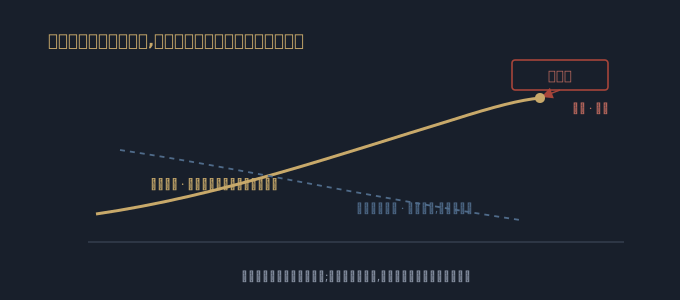
The hardest thing about an interest rate isn’t how high it sits — it’s who actually sets it. The dangerous moment in a tightening isn’t when the Fed raises its hand; it’s the weeks before, when the market has already raised that hand for it and everyone is still staring at the Fed, waiting. What makes money expensive is never the September meeting. It is the stretch of days before it, when the market votes the rate up, one trade at a time.
The read is everywhere: the Fed has turned hawkish. It held in July but left a hard line behind — someone on the committee dissented outright, wanting a hike right then; officials have been out this week saying now is the time to raise. So everyone reads September’s meeting as the Fed about to tighten. On the August 6th session — the close that lands in the small hours Beijing time — the rate-sensitive corners led the tape down; utilities and property trusts took one of their worst weeks of the year. And this Friday morning, the tape holds its breath for the July jobs report, as if the moment that page lands, the Fed’s hand will fall with it.
That read mistakes the one who stamps for the one who acts.
The Fed is not tightening. The market is. September’s hike, if it even comes, only stamps a tightening that already happened.
Start with who sets “the rate.” The rate everyone names is a number a handful of people vote on in a room. But the rate with its hand around your throat is not that one. Your mortgage, a company’s borrowing, every debt that has to be rolled — they all watch the two-year Treasury yield, a line that is millions of people’s live bet on how dear money will be two years out. Lately that line has been climbing on its own. Before the committee has even sat down, the market has already priced the hike into it, cent by cent. When September comes, all they will do is ratify a line the market lifted weeks ago.
The hand that tightens is always the market’s. The Fed is only the one who stamps it, last.
The rate-sensitive assets have already said as much. A utility, a property trust, is worth the future’s steady trickle of cash discounted back to today. Widen that discount and they drop on the spot — no need to wait for the Fed’s hand; the moment the market lifts the discount, they have already fallen. The beating they took this week was not dealt by September’s meeting. It was dealt by the market, weeks early. You think you are waiting on a decision; the decision was already made, out in a hundred thousand trades, by everyone at once.
Here is the loop. The market’s front-running the rate higher is itself the tightening. Money gets dearer, fewer hands reach to borrow, the places that should cool cool off — the market does the tightening while shouting that the Fed is about to. Which spins up a reflexive twist: precisely because the market tightened hard and early, by the time the Fed steps to the microphone, what should have chilled has already gone cold, and the hike may not even be needed. The market calls for the Fed to act, then acts before it — and arrives to find its own work already done. Price forecasts the tightening and, with the same hand, makes the forecast come true. It is both the prophecy and the hand that fulfills it.
Then what is this Friday’s jobs report? Not a decision. The market’s price already carries both branches — a strong print, a weak print — each with its odds baked in. The page landing only stamps this one onto a fork the market laid down long ago. The number conjures no direction; it merely lights up one of the possibilities already computed. Everyone holds their breath at this instant, sure the direction is born here. It was spread across every trade of the past weeks; today just gathers it into a point.
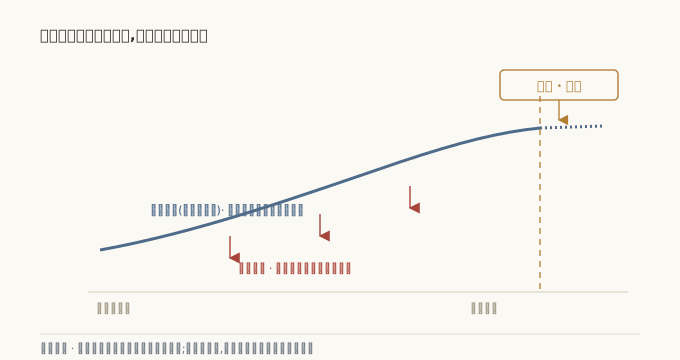
At bottom, people always want someone in charge — a hand that lifts, a gavel that falls, a person to answer for a machine that runs itself. So we cast the Fed’s few faces as the authors of the rate. But the rate has no author. It is the resultant of millions of bets, a referendum with no chair, a number the crowd computes for itself. The Fed does not stand above that vote; it stands inside it, one ballot like everyone else’s — and usually the last one cast, going with the tide it pretends to command. To think you can pin that number down and rule the room is to mistake a whole network for a single button you can press.
In the end, in front of a machine that does its own arithmetic, we keep hunting for the one visible hand — so that a question no one can answer might have someone to blame: how dear should money be? No set of faces can call it. So we settle for the next best thing and watch the Fed’s mouth, as if dear or cheap were its to declare. It is not. It is one ballot in the great referendum, only cast later and louder. You think you are waiting on the gavel. The hand that tightened money, cent by cent, finished the job out in the market weeks ago — one trade at a time.
You think you are waiting on the Fed's gavel; the market swung it for them, one trade at a time, weeks ago.
SECURE PAYMENT VIA STRIPE
Subscribe: $50 annual pass unlocks every paid article on this site for one year
Go deeper: Ko-fi members get a weekly members-only deep dive, from $3/month Become a member →