Brent Crude Jumped 3.4% to Above $101 a Barrel on Wednesday, September 9, and the 10-Year Treasury Yield Climbed to Its Highest Since November 2023 the Same Day, With the Dow Closing Down 0.77% — What Fell Wasn't Risk Appetite, It Was the Denominator Sitting Over Every Asset in the Market!
There’s a popular read going around right now: US stocks fell this week because of a textbook risk-off selloff — a whiff of trouble, and money runs for the exits, another bout of market nerves. It’s a convenient story, because it doesn’t require checking any arithmetic. You just decide people got scared, and that explains everything. What it misses is the one thing that actually moved these past two days.
The US session behind this morning’s (September 10) Beijing close was Wednesday, September 9 in New York. All three major indexes closed lower together: the Dow down 0.77%, the S&P 500 down 0.48%, the Nasdaq down 0.64%. None of those numbers is dramatic on its own, but the direction was uniform — nobody got a pass. If a portfolio split evenly across all three, the whole thing quietly lost a chunk of a percent that day without any single name blowing up.
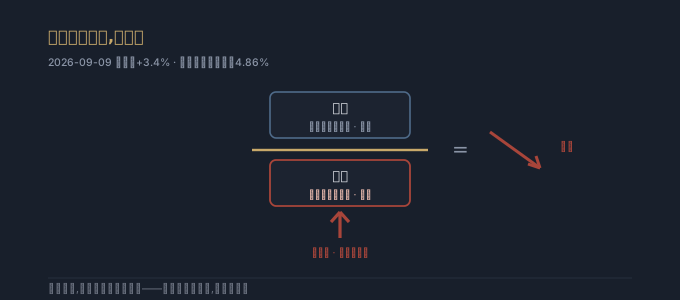
The real protagonist is hiding behind those percentage points. A stock, an index — its price was never a number that grew out of nowhere. It’s a fraction: the numerator is the money it’s expected to earn in the future, and the denominator is the price you have to pay today to convert that future money into today’s dollars. Finance has a name for that denominator — the discount rate — but you don’t need to memorize the term. You only need to remember one thing: the numerator didn’t move. The moment the denominator gets more expensive, whatever number falls out of that fraction has to come down with it.
This week, the denominator got shoved upward by a barrel of oil. Brent crude jumped 3.4% that day, crossing $101 a barrel — roughly the cost of a few extra dollars at the pump for filling up an ordinary family car, not a dramatic move on its own. But oil is raw material for inflation expectations, not a footnote to them. The moment inflation expectations tick up, the price of borrowing money rises with it: the 10-year Treasury yield climbed to roughly 4.86% that day, its highest level since November 2023 — meaning lending the US government money for ten years costs more today than on any day in nearly three years. The 10-year yield isn’t a thermometer for how scared the room is; reading it was never about measuring anyone’s temperature. It’s the denominator nearly every asset on earth gets priced against, and when it moves on its own, the fraction’s answer has to move with it — no one needs to be “afraid” for that to happen.
A pricier denominator rewrote something else too: the debate going into the September 16 FOMC meeting had been cut versus hold, and CME FedWatch’s implied probability of a hike has climbed from under 40% three weeks ago to past 50% these past few days — three weeks ago, most bets leaned toward holding or cutting; this week, most bets have flipped toward a hike. Wind the clock back three weeks, and what moved this denominator was a whole slate of data — jobs, retail sales, spending — none of it dominant on its own. That’s changed. These past few days, to a large extent, the denominator gets recalculated the moment oil moves on a given day. The set of inputs narrowed from a whole portfolio down to almost one. That’s not an accident breaking the pattern — it’s the pattern arriving exactly where it was headed.
When the denominator rises, the arithmetic runs one way: the same dollar owed ten years from now, converted back to today, shrinks; the more an asset’s price rests on a story that only pays off many years out, the harder it shrinks in translation; and that shrinkage isn’t nerves spreading person to person — it’s the network faithfully folding the new denominator into every quote on the board. Run the clock back a few weeks, when the market was still betting on a September 16 cut, and the arithmetic ran the other way: the same future dollar, converted back, got bigger; long-duration story stocks rallied the hardest; and that rally was never exuberance either — it was the same fraction, fed a smaller denominator, spitting out a different answer. Nobody calls a rally “greedy buying” when the denominator falls. Somehow a decline always gets called “panic selling.” The move itself is symmetric. The label humans slap on it never is.
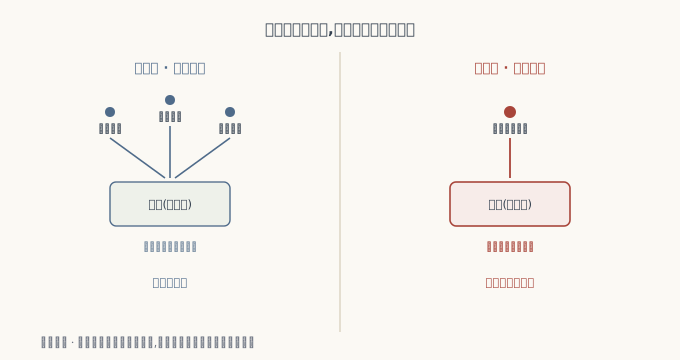
Back to the risk-off story from the top. It isn’t wrong about direction — it’s backwards about cause and effect, mistaking the outcome for the trigger. Money did flow out of risk assets these past two days, but that was never the cause — it’s what the arithmetic automatically spits out once the denominator gets pricier. The ledger moved first, and positioning followed the ledger; people didn’t get scared and then the ledger moved to match. At bottom, reading a mechanical repricing as a collective emotional breakdown is mistaking a calculator that’s running exactly as designed for a crowd in a panic.
What’s most unsparing about this arithmetic is that it never accommodates anyone’s position, anyone’s conviction, anyone’s confident call from yesterday. It doesn’t care how many people agree, or whose story sounds most compelling. It cares about exactly two things: did the numerator move, and did the denominator move. People naturally reach for the explanation they can feel in their gut — a whiff of trouble, and everyone got scared — because that story has a plot, a protagonist, an emotional arc, and it sounds like it must be true. But price was never written by feeling. It’s what this fraction, recalculated fresh every single day, coldly produces. What actually moves everything at once was never anyone’s mood. It’s the denominator hanging over every asset on the board, the one no single person gets to move on their own.
What fell was never sentiment. It was the number the fraction honestly produced once the numerator held still and the denominator got recalculated.
SECURE PAYMENT VIA STRIPE
Subscribe: $50 annual pass unlocks every paid article on this site for one year
Go deeper: Ko-fi members get a weekly members-only deep dive, from $3/month Become a member →