ADP Reported Just 38,000 New Jobs Wednesday and Stocks Rallied — Friday's Payrolls Report Smashed It at 162,000, Nearly Triple the Forecast, and the Dow Dropped 271 Points — The Data Didn't Contradict Itself, In This Regime Bad News Really Is Good News!
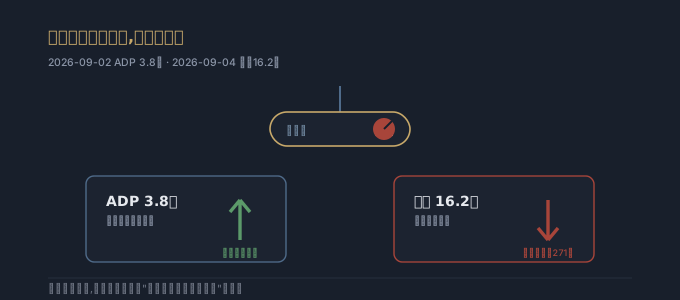
The hardest thing about reading an economic number was never whether it looks respectable. It’s whether it lands on the side of the switch that decides whether “respectable” counts as good news at all. What markets fear was never bad news itself — it’s a perfectly solid piece of good news landing on the wrong setting. What actually happened this week wasn’t two data releases contradicting each other. It was the same switch grading two report cards from the same economy, two days apart, and handing them the same verdict.
The US trading session behind this morning’s (September 5) Beijing close was Friday, September 4 in New York. The evening before, the Labor Department released the August jobs report: nonfarm payrolls up 162,000, against a consensus of just north of 50,000 — the actual print came in near triple what the forecast called for, the kind of number that catches a market flat-footed. Unemployment held at 4.1%, dead on expectations. On paper, this was about as clean a beat as a jobs report gets.
And yet the Dow closed down 271 points that day, off 0.51%, with the S&P and Nasdaq sliding in step. All three major indexes turned lower together.
Here’s the part that makes it interesting: just two days before, on Wednesday, September 2, the same economy had turned in a very different report card. ADP’s read on private-sector hiring came in at only 38,000 — one of the weakest monthly prints of the year. And on the day that unimpressive number landed, stocks didn’t fall. They rallied, across the board. Thirty-eight thousand against a hundred and sixty-two thousand — one weak, one strong, pointing in opposite directions. And the stock market’s reaction on those two days also pointed in opposite directions — just running exactly counter to which number was actually stronger.
This isn’t a coincidence, and it isn’t the market having a mood swing. Price is part of credit, and what credit reacts to first was never “is the economy doing well” — it’s “is the central bank about to tighten.” For weeks now, the collective scale everyone’s watching has quietly shifted from “will this tip into recession” to “will inflation get away from us, and does the September 16 meeting need a hike.” Once the scale moves, the question any given number is answering changes with it. A weak print no longer means “the economy is in trouble” — it means “the Fed doesn’t need to tighten,” which is exactly why a number as unglamorous as 38,000 turned into the sentence the market wanted to hear. A strong print no longer means “the economy is genuinely holding up” — it means “the case for tightening just got stronger,” which is exactly why a number as impressive as 162,000 turned into the sentence the market most dreaded. Same scale. The reading just got flipped end to end.
The most interesting part of this switch is that it corrects itself, and it corrects itself in the direction of putting itself out of a job. Follow the chain one step further: once a print as strong as 162,000 locks in the case for tightening, borrowing costs tick up a notch; costs ticking up cools real spending by businesses and households a step later; that cooling shows up as a softer print next month. But once next month’s number actually comes in soft, the very same switch will grade that softness as good news — this regime is, right now, quietly writing tomorrow’s “bad news” into next month’s “good news.” The tightness the rule is forcing today is busy manufacturing the exact excuse it will use to loosen tomorrow. That’s a self-correcting loop, not a self-reinforcing one: past a certain point, the system lets its own hand off the lever — nobody has to reach in and stop it.
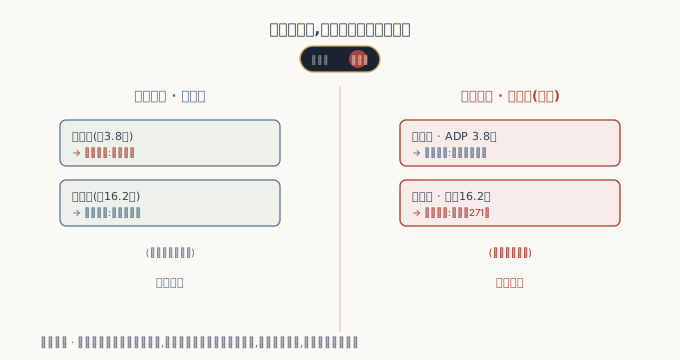
Back to the two popular reads from the top. The “markets are just moody” crowd misses this: there was no mood swing at all. What swung was the strength of the data — the reading rule stayed perfectly consistent the whole time. As long as the switch hasn’t flipped back, weak prints keep getting read as bullish and strong prints keep getting read as bearish, this week and next. That’s not fickleness. That’s the rule being exactly as consistent as it claims to be. The “this payrolls number must be fake” crowd misses the other half: ADP and the official payrolls report were never measuring the same thing to begin with. One samples its own private-sector book; the other is the Labor Department’s much broader survey across the whole economy, different method, different scope. Thirty-eight thousand and a hundred and sixty-two thousand were never obligated to look alike. Treating two different ledgers, tallied two different ways, as proof that one of them must be lying is mistaking two separate accounts for a single one that doesn’t balance.
People naturally want one universal standard for good and bad — up should always mean good news, down should always mean bad, because that version asks nothing of you and doesn’t care what the backdrop is. But a complex system was never built to keep books that lazily. What it actually records, always, is the relationship at the moment a number collides with a rule: the same figure is good news under one setting and bad news under another, and the figure itself never moved an inch — what moved was which question it got asked to answer. At bottom, trying to call the next move by staring harder at the next data print is crediting the data for a job that belongs to the switch. What actually decides who wins and who loses this week and next was never how big the next headline number turns out to be. It’s which way the switch hanging over every single release — the one deciding which direction a number gets read in — happens to be thrown, right now.
What rallied was never the good news, and what fell was never the bad news — what moved was the switch that decides which one a number counts as, and today it was thrown the other way.
SECURE PAYMENT VIA STRIPE
Subscribe: $50 annual pass unlocks every paid article on this site for one year
Go deeper: Ko-fi members get a weekly members-only deep dive, from $3/month Become a member →