The Fed Hiked for the First Time in Three Years and the Textbook Said Banks Would Cheer — Instead Goldman Led the Dow Down While the Nasdaq Barely Moved. A Bank Never Earns the Interest Rate, Only the Part That Gets Repaid!
There is a claim that has made its way into nearly every textbook, and that has been recited on repeat for the past month: rate hikes are good for banks. The logic sounds self-evident. Banks are in the spread business; when the price of borrowing goes up, the gap between what they pay on deposits and what they earn on loans widens, and they simply make more. This is shop-counter thinking — it treats a bank as a store that sells interest rates. Rates are the merchandise, a hike is a price increase, and a price increase is obviously good for whoever is selling.
On Wednesday, September 16, the closing bell turned that sentence inside out in front of everyone.
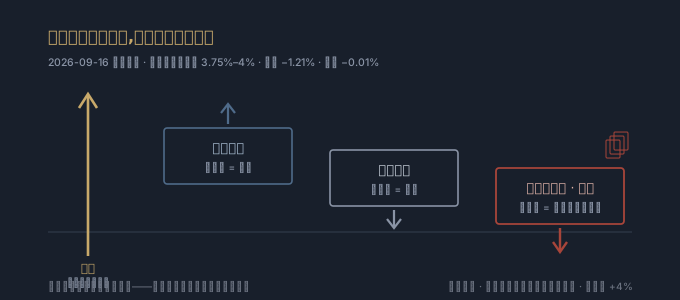
At 2 p.m. Eastern, the Federal Reserve raised the federal funds rate by a quarter point to 3.75%–4%. It was the first hike since July 2023, and it passed 12–0, without a single dissent. By the textbook script, that was the moment banks should have lifted their heads.
Instead, at the close, the Dow was down 1.21% — more than six hundred points — with Goldman Sachs leading the way lower. The largest banks sold off together, most of them down two to four percent, and the bank group had its worst day since late February. And the end of the market that is supposed to fear hikes most, the one that should have been hit hardest by a higher discount rate — the Nasdaq — closed down 0.01%. It barely moved.
Something labeled good news arrived, and its supposed beneficiaries were the day’s biggest losers. That is not the market misreading the textbook. It is the textbook putting the bank in the wrong place from the start.
A bank never earns the interest rate. It earns the part of the interest rate that gets repaid.
Take that sentence apart. What are a bank’s assets? Loans and bonds — which is to say, other people’s liabilities, other people’s promises. The spread is a nominal number written into a contract. What actually reaches the income statement is only the portion the borrower brings back in cash. When rates go up, the number in the contract does get bigger. But so does the borrower’s bill. A hike is not a raise for the bank; it is an invoice mailed to the bank’s customers — and whether those invoices eventually get paid is what determines whether the bank made any money at all.
In that sense, rate hikes are good for banks is not wrong. It is expired. It is a memory left over from the opening stretch of a hiking cycle.
Set the two phases side by side and the difference is stark. Early in a hiking cycle, rates start from very low: deposit rates are slow to respond, loan rates reprice first, bad debts are sitting at the bottom, and borrowers can carry the extra interest with room to spare. A hike then really does widen the spread; the bank really is the winner, and good for banks is earned. Late in the cycle it is another story. The price of money is already high — the 10-year Treasury is hovering near 5% — and now comes another quarter point, with 16 of 18 officials saying at least one more is coming before year-end. Deposit costs have already caught up. The bonds the bank bought at lower yields take another cut, and the paper loss goes a layer deeper. The share of every dollar a borrower earns that goes to interest keeps climbing — and the part of the rate that actually gets repaid starts to thin out. The same sentence, rate hikes are good for banks, is a truth early in the cycle and a trap late in it.
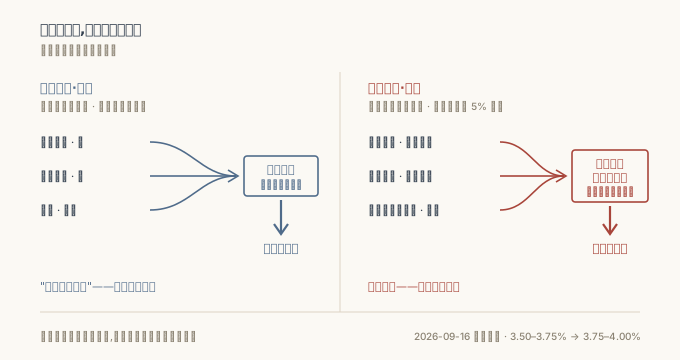
In fact, one sentence that day weighed more than the hike itself, and it came from the chairman at the press conference: he would be “hard pressed to describe broad financial conditions as restrictive,” and this move merely “removed a dose of accommodation.” In plain English: rates went up, but money still isn’t expensive, and the tightening isn’t done. The market heard the subtext. What is about to be tightened is not just an overnight rate — it is the entire credit network. And inside that network, the pipe responsible for turning a rate into tight is the bank.
There is a reflexive loop here that almost everyone skips over. A hike raises the borrower’s bill; a heavier bill raises expected defaults; higher expected defaults hit bank stocks first; falling bank stocks make banks pull in their lending; pulled-in credit slows the economy; a slower economy weakens borrowers further, and expected defaults rise again. In that loop, the bank is not the man on the shore collecting interest. It is the pipe under pressure. Pressure gets added upstream, and the pipe does not profit from it — the pipe takes the strain first. The Fed sets the rate; the banks set the credit. A rate only becomes tightening once it passes through the bank, and when it does, the first thing to hurt is always the gate itself.
Now look at the other end of the same session. The Nasdaq barely moved, and Intel deserves some of the credit — it rose 4% on its own news, nothing to do with rates. But set that one aside, and the way the market sorted winners from losers that day was not growth versus value, and not near cash flows versus far ones. It was a plainer question: are you holding cash, or are you holding someone else’s IOU? For the company sitting on cash, a higher rate is income. For the company that owes money, it is a bill. The bank is neither — what it holds is a thick stack of other people’s paper. When rates rise, the number on the paper gets bigger. The quality of the paper gets worse.
Fundamentally, the interest rate is the price of the whole credit network; it belongs to no single node. People like to ask who benefits from a hike the way they might ask which dock benefits from a rising tide. The tide does not work for any dock. It lifts the whole sea at once — and whoever tied their boat loosely, whoever drove their pilings shallow, is the first to have a problem. A bank’s pilings are driven into other people’s promises.
People always place themselves a little higher than they actually stand. The bank believes it sells interest rates when it is only the channel they pass through. The investor believes they have learned a law — hikes are good for banks — when they have memorized the skin of one stretch of a cycle. The market does not care which textbook you read. It reprices every node according to this moment, and to the true quality of every IOU outstanding. A complex system does not reward the people who remember the rule. It rewards the people who know when the rule expires.
When rates rise, the first to feel their weight is not the one collecting interest — it is the one holding the paper.
SECURE PAYMENT VIA STRIPE
Subscribe: $50 annual pass unlocks every paid article on this site for one year
Go deeper: Ko-fi members get a weekly members-only deep dive, from $3/month Become a member →