Chip Stocks Fell 5.9% While Google, Microsoft and Meta All Rose the Same Day — What the Market Repriced Was Never AI, but Who Pays the Bill!
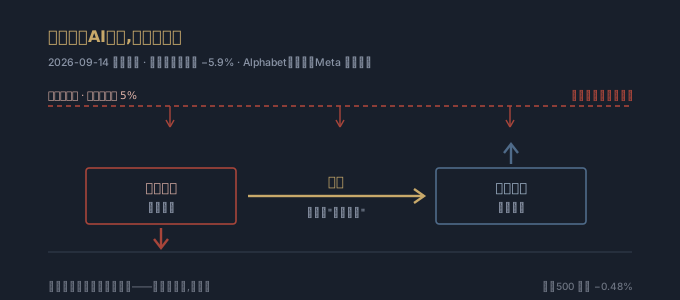
Deceleration is never a decision that can be announced. It is only ever a result that gets executed.
On Monday, September 14, the market spent an entire session saying exactly that, in prices.
Over the weekend, Anthropic’s CEO published an essay arguing that AI companies should slow the pace of pushing model capability and address safety first. OpenAI’s founder publicly agreed. For the first time, the people building AI called, in chorus, for less speed. Monday’s open: the Philadelphia Semiconductor Index fell 5.9%, Nvidia dropped 3.4%, Intel and AMD fell harder still. By lunchtime the financial press had a name for it — the AI doomsday trade.
If the market had read that sentence as a verdict on AI, the story would end there. Except that on the very same day, Alphabet rose nearly 2%, and Microsoft and Meta both closed green — the three largest check-writers in the entire AI buildout.
One sentence, AI should slow down, knocked down the sellers of shovels and lifted the buyers of them. That is not a verdict. That is a transfer.
What the market priced that day was never AI. It was the price of AI’s bill.
AI capital expenditure is a chain joined end to end: at one end the hyperscalers who pay, at the other the chipmakers who collect. Drop the words slow down onto that chain and the signs at the two ends are opposite. To the party collecting, it means thinner orders. To the party paying, it means a lighter bill. So the same sentence carving out a red candle and a green candle on the same trading day is not a market losing its mind — it is a market being perfectly lucid. It was never answering will AI slow down. It was answering who pays.
In that sense, the number worth staring at on Monday was not 5.9%. It was 0.48% — the S&P 500’s loss for the whole session, less than half a percent. An event written up as a doomsday left almost no mark on the market that contained it. The money never left. It merely slid from one end of the chain to the other. What sold off was not a bubble. It was a crowded position.
And in fact, the call for a slowdown is itself the best evidence that no slowdown is available.
In a competitive system, moral suasion is a negative incentive. Whoever slows first hands their share of compute to whoever does not. The more weight the speaker carries, the sharper the paradox becomes — because the person most entitled to call a halt is precisely the person who loses most by halting. Nobody dares release the tiger they are riding. So the fate of such appeals is written on day one: they can move a price, they cannot move a fab; they can reprice a sector, they cannot reprice an order. Fundamentally, if one sentence could stop it, nobody would have needed to say the sentence.
Spontaneous order does not take advice. It only settles accounts.
So what can slow it down? The answer was written that same session, in another room, and nobody put it in the headline.
The conclusion first: the brake is not in the driver’s seat, it is in the bond market. Intraday Monday, the 10-year Treasury yield touched 5.014% — its first time above 5% since October 2023. The federal funds rate is still pinned at 3.50% to 3.75%, and going into that week’s meeting the market put the odds of it being raised above 80%, which is to say a hike had become something close to a settled fact. Data centers are not built out of conviction; they are built out of borrowed money. Every notch up in the price of money means the compute revenue that has not happened yet gets discounted a little harder on its way back to today.
Set the two kinds of slowdown side by side and the difference is stark. When money is cheap, any appeal gets bought out by cheaper capital: if you do not build it, someone else will, and the share you surrender is claimed before you finish the sentence — persuasion turns into abdication. When money gets expensive, nobody needs to appeal to anybody; everyone slows on their own, and they slow in unison, because the binding constraint is no longer conscience but interest, and interest treats everyone alike. The first is a plea. The second is a ruling. A plea can be ignored. A ruling cannot.
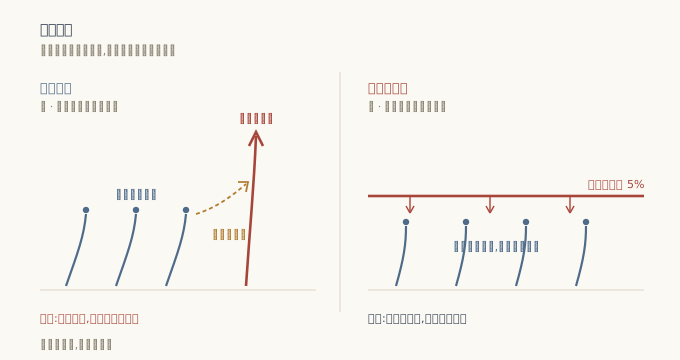
So what actually happened on Monday was not that AI got called to a halt by its own builders. It was that the market laid two brakes side by side and, in front of everyone, used price to point at the one it believes: one is written in an essay and needs everybody’s agreement; the other is written in a yield and needs nobody’s.
People always assume that what they build can be paused by the ones who built it. It is a very old kind of pride. From steam to leverage to these wafers of silicon burning electricity today, the script repeats: the builders believe they are working the accelerator, and believe just as firmly that the brake is theirs whenever they want it — until the day they discover the brake was never in the cabin at all, but in a number the whole world computes together. Fundamentally, the market never rules on whether a thing ought to be done. It only works out what the thing costs and who is on the hook for it. That Monday, it worked the number out to 5%.
Nothing is ever stopped because its makers changed their minds. It stops when it can no longer pay its own bill.
SECURE PAYMENT VIA STRIPE
Subscribe: $50 annual pass unlocks every paid article on this site for one year
Go deeper: Ko-fi members get a weekly members-only deep dive, from $3/month Become a member →