Meta's New AI Agent 'Muse' Hit No. 1 on the US App Store in Ten Days, and Chip Stocks Roared — Everyone Assumed It Was Nvidia's Stage Again, Yet the Two Names That Actually Ripped Were Intel, Up More Than 12%, and AMD, Crossing a $1 Trillion Market Cap for the First Time, While Nvidia Was Left Far Behind — What Gets Repriced Is Never the Best Chip Story, It Is Whichever Node in the Network Has the Deepest Shortage!
The price of compute was never shouted out by one company. It is a number the whole network works out for itself.
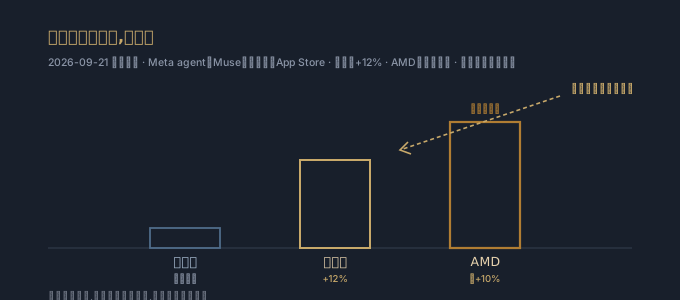
Monday, September 21 (US Eastern) — early Tuesday in Beijing — the market said that sentence again, in its own language. Stocks closed broadly higher that day, the Nasdaq notched a fresh record close, and the Philadelphia Semiconductor Index led the charge, up more than three percent. The spark was specific: Meta’s new AI agent — software that can act on a user’s behalf without being walked through every step — called Muse, had climbed to No. 1 on the US App Store’s overall chart in just ten days. Financial headlines almost unanimously filed this under “AI is back,” carrying an unspoken assumption underneath: that this was still Nvidia’s stage, that Nvidia up meant the story was heating back up and Nvidia down meant it was cooling off. That is a lazy algorithm for reading a whole network — collapse it down to one ticker, and assume its pulse is the industry’s pulse.
That day’s leaderboard tore the shortcut apart. The two names that actually topped the gainers were Intel, up more than 12% on the day, and AMD, up close to 10% and crossing a $1 trillion market cap for the first time — the fourth US chipmaker to clear that bar, after Nvidia, Broadcom, and Micron. Nvidia rose too, of course. It was simply left far behind. If “Nvidia equals AI” still held, this should have been its day alone. What actually got repriced was never the story Nvidia tells.
Underneath is a real shift in capacity, not a shift in mood. For the past few years, almost the entire AI compute narrative has lived on the training side — burning through oceans of GPUs to train a model from scratch, with Nvidia standing as the one bottleneck the market had verified over and over. Naturally, capital only recognized that one entry point. What the Muse headline actually moved was a realization: AI is sliding from training toward inference — the phase where a trained model gets called on, over and over, by hundreds of millions of users doing actual tasks. What gets squeezed in that phase is no longer just the expensive GPU doing the training. It’s the CPU behind every single call, doing the scheduling, the retrieval, the decision-making. The network had exposed a second bottleneck, and capital went with the current straight toward it.
That bottleneck wasn’t a story capital talked itself into — it had a receipt. Earlier in the week, Intel’s CEO said in a public conversation that CPU orders were running so hot the company could “only supply about half of what customers want.” Translated into plain terms: of every two companies that come knocking, only one gets its order filled on time. The other waits in line for capacity that doesn’t exist yet. That’s not a flattering soundbite. It’s an admission of a hard physical ceiling.
Once a shortage gets admitted out loud, it starts reinforcing itself. Money flows toward Intel, which gives Intel more room to push its expansion plans — like the memory-manufacturing tie-up it’s been discussing, building capacity on US soil together with a storage-chip partner. News of that expansion leaks out, which in turn confirms the shortage was real, which pulls in still more money behind it. ① The shortage gets admitted, ② capital rushes in and validates that the shortage is real, ③ that validation supports the shortage being admitted further still — a self-reinforcing loop. Its starting point was never how good Nvidia’s story sounded. It was whichever string in the network was already pulled tightest.
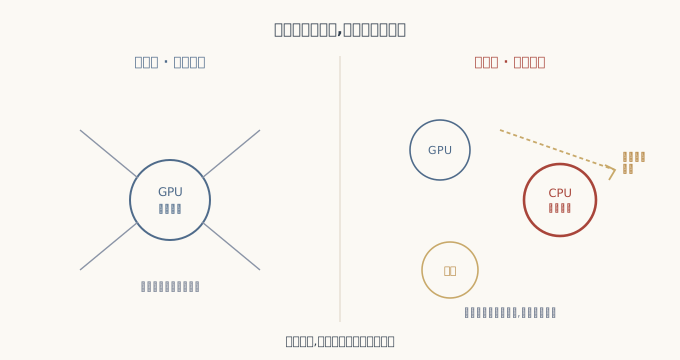
Fundamentally, a complex system never recognizes a single button. People like collapsing an entire network down to one symbol — a company, an index, a figurehead — because it’s a cheaper way to understand the world. The cost of that cheapness is that what the network is actually doing stays hidden in everything the shortcut left out. Nobody issued an order that day to move money into CPUs. No memo, no vote decided that capital should rotate out of GPUs and into Intel and AMD. What moved it was nothing more than countless separate accounts, each independently and honestly asking the same question — where in this network is the shortage tightest right now? — and then, naturally, sending money there. That is what spontaneous order actually looks like: no center, no command, and yet the same answer arrived on the same day, computed independently and simultaneously by thousands of separate ledgers that never once talked to each other.
The price of compute was never a name shouted loud enough. It is the shortage the network works out for itself.
SECURE PAYMENT VIA STRIPE
Subscribe: $50 annual pass unlocks every paid article on this site for one year
Go deeper: Ko-fi members get a weekly members-only deep dive, from $3/month Become a member →