Warsh Speaks at Jackson Hole, Rate-Hike Odds Clear Fifty Percent in a Day — the Rate Itself Hasn't Moved One Basis Point, Only Everyone's Bets on Each Other Have!
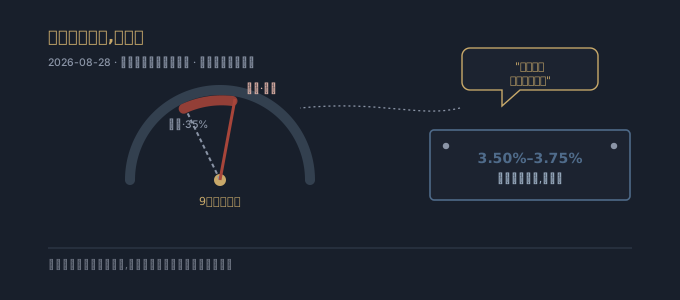
A claim is making the rounds: Warsh opened his mouth at Jackson Hole, hike odds cleared fifty percent in a day, so inflation must be spiraling out of control again and the Fed is pivoting hawkish. This is a familiar sleight of hand — mistaking a trading desk’s overnight change of heart for a move in inflation itself, mistaking a needle swinging on a probability dial for the rate actually having moved.
Beijing time’s pre-dawn close today tracks Wall Street’s Friday session — August 28. New Fed Chair Kevin Warsh gave the first major keynote of his chairmanship, and he was careful about it: recent inflation prints look a touch cooler, he said, but “underlying trends have not meaningfully improved.” He never once said the words “hike in September.” The market wrote that sentence for him anyway — the odds of a September hike jumped from the low thirties on Thursday to past fifty percent within the session, and the 2-year Treasury yield spiked to a one-month high of 4.29%. The S&P dipped slightly and the Nasdaq slid 0.52%, semiconductors dragging it down again. A sentence that made no promise got the entire front end of the yield curve to foot the bill.
But the ledger doesn’t close on one day. The number actually underwriting the claim that “inflation hasn’t really cooled” was already sitting on the table two days earlier, on August 26: core PCE, up 3.3% year over year. Warsh wasn’t reading out new information Friday — he was re-reading old information in a new tone. The federal funds rate itself has sat at 3.50%-3.75% for five consecutive meetings, unmoved, not one basis point in either direction. The data didn’t change. The rate didn’t change. What actually flipped in a single day was everyone’s bet on everyone else. Odds are not a forecast. They are a position.
There’s an earlier chapter behind this that the headlines skipped. At the July 29 meeting, three policymakers — Cleveland Fed’s Beth Hammack, Minneapolis Fed’s Neel Kashkari, and Dallas Fed’s Lorie Logan — dissented in favor of hiking a quarter point immediately. Three officials dissenting in the same hawkish direction at once hadn’t happened in almost ten years. Warsh didn’t invent this hawkish faction out of nothing this week; the disagreement had already been sitting on the table since late July, waiting for someone willing to say it out loud in public. His speech didn’t so much dictate a pivot as hand a pre-existing, long-simmering disagreement a stage to bet on in the open. What actually prices the rate path was never one chairman’s mouth — it’s the aggregate computing power of everyone positioning at once. His words were the trigger, not the ammunition.
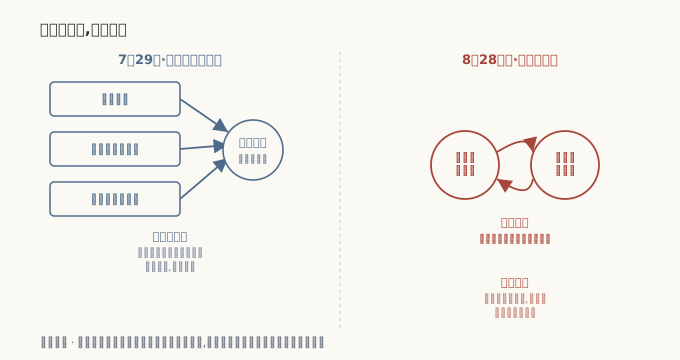
That’s the difference between early and late. The three July 29 dissents were the output of independent inputs each run through its own math: inflation data, energy and supply-side prices, regional economic conditions — three officials computed separately and arrived, separately, at the same conclusion. That’s distributed computing, grounded in reality. But the odds spike that followed August 28 isn’t running on new information — the same core PCE print had already been sitting there for two days. What’s actually running is a closed loop of mutual guessing: I bet you’ll reposition because of what Warsh said, so I reposition first; you bet I’ll reposition first, so you do too. Compute has collapsed down to a single self-referential arrow — position feeding position — no longer pricing fundamentals, only pricing the speed of everyone else’s reaction.
This reflexive loop has a more concrete edge to it, too: the odds themselves are part of the credit environment. The moment front-end yields spike, financing costs tick up immediately, and financial conditions tighten a notch right there — none of it requires the Fed to actually vote for a hike. The mere belief that they might, held by enough people at once, is already partially self-fulfilling. Price was never a thermometer reading inflation from outside; it’s a node inside the credit network itself. What moved this time wasn’t the thermometer’s reading — it was the node tensing up on its own.
People are constitutionally impatient with letting distributed computation run every independent judgment to completion; they’d rather seize on one loud enough sentence and buy out the uncertainty in a single stroke. Warsh’s “trends have not meaningfully improved” handed that impatience exactly the excuse it wanted — one sentence out, and trading desks went into a defensive crouch, throwing fuel on their own fire, one stone setting off a thousand ripples that had nothing to do with the inflation data itself and everything to do with a backlog of disagreement that was already primed to catch. But a complex system never ships in bulk. It computes node by node, day after day, with no single verdict handed down all at once — only an endless, independently-run reconciliation. At bottom, the more violently and uniformly a probability needle swings, the further its reasoning has drifted from anything the real world actually computed.
The rate cannot raise itself. Odds, for one day, can raise themselves on everyone’s behalf.
The dial stayed bolted to the wall without moving an inch — it was the needle that went ahead and cast everyone's vote for them.
SECURE PAYMENT VIA STRIPE
Subscribe: $50 annual pass unlocks every paid article on this site for one year
Go deeper: Ko-fi members get a weekly members-only deep dive, from $3/month Become a member →